
Whenever someone asks what I do for work, I typically tell them that it’s in IT. If I were to elaborate a little, I’d state that I’m a Systems Admin. It’s still a broad term, but the most common reason for someone to ask that question in the first place is to establish some common ground. If I started to ramble about the particulars of my work, they likely wouldn’t know what I’m talking about, let alone be interested… It’s not to say the person I’m speaking to is a numb skull, but rather, there are so many professions, and lots of these have various specialisms within. It’d be unreasonable to think that someone would know about the specifics of my work, even if it’s not particularly difficult as a whole.
The other week, I came across someone I know in the City Centre. As we were chatting, I asked him where exactly he worked, as he wore a bicycle helmet, and it looked as though he was about to head home. He told me where it was, and he then went on to tell me exactly what he did. I found it intriguing, but when he started to mention specifics, I switched off a little. I didn’t understand the words he was using and why they’re important. This is why it’s often useful to speak in Layman’s terms, which is to describe something in a way that someone without prior experience of a particular subject can resonate with.
I’d like to share an idea I’ve coined to describe my work to some degree. I realise this won’t be very interesting, but as I’m sat here mulling around ideas in in my head, I thought it could be useful to write about if the scenario where it’s required presents itself in the future.
Ok, so you’re familiar with the basic concept of computers? A circuit is designed to fire 2 signals; one of a higher voltage, and one of a lower voltage. This presents itself as binary code, or a series of 0’s and 1’s, which is a something you may have heard before. Now, imagine there are 4 component layers below the final 5th layer; the 5th layer being you sat behind a desk and interacting with the laptop/mobile/desktop to access the internet and type up documents, etc. So what are the other 4 layers? Layer 1 could be defined as the Physical layer; this layer is made up of the circuitry used to create the binary code I’ve just mentioned. Layer 2 could be defined as the Low Level Software Layer. This layer is made up of the methods used to develop basic software and Programming Languages. Think of this in a similar way to a governing body of an organisation who exclusively define the rules of what’s possible. This allows for work on Layer 3, which we’ll call the Software Engineering Layer. Think of the people in movies vigorously typing onto their keyboards as they prevent hackers from hijacking the system. In reality, I don’t think it looks like that, but think of these as the people who develop the applications you use each day. Word Processors, Internet Browsers, Social Media platforms; they all have a developer behind them writing it’s code. Layer 4 could be where you’d say I sit. We’ll call this the Configuration Layer. It’s not an immensely skilled layer by any means, but it is useful. In organisations where 1000’s of devices must be managed effectively, you need standardised delivery mechanisms for these services. Think about what it takes for you to login with a username and password; the software that’s installed, and how it looks. To achieve this, scripts might be designed and configured to automate these tasks. Finally, Layer 5 could be the person sitting behind the screen using these functions for purposes other than something directly related to IT, such as a Doctor entering patient records into a system.
In Computer Networking, the OSI Model is typically represented in a similar way to what I’ve just described. However, the OSI model is made up of 7 layers, and more importantly, it hasn’t been made up on a whim like mine. This visual might help to make clear of the layers I suggested earlier. Don’t focus on the individual items, but the concept.
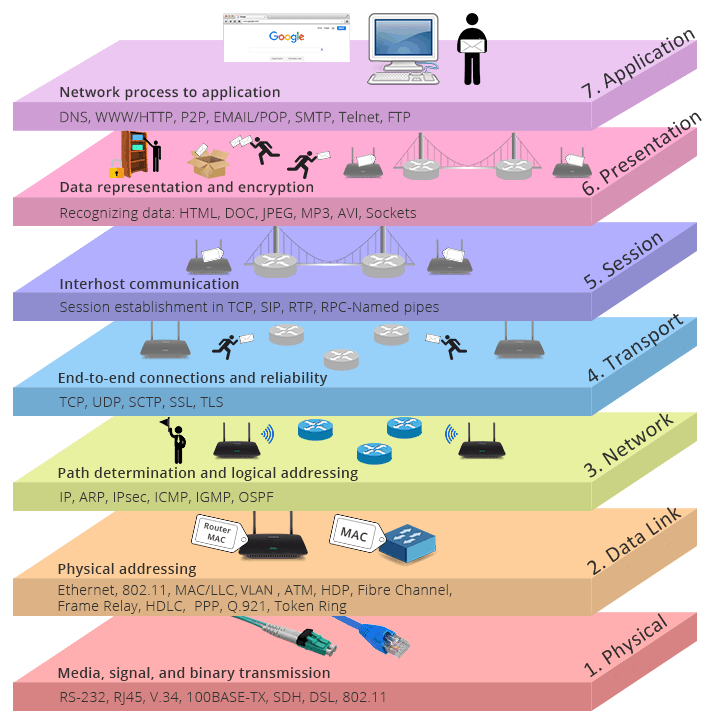
Anyway, that was my intention; not to offer a credible hypothesis on computer software layering. After all, I’m not a computer scientist; far from it. My motive behind this post has been to offer a thought into how we might articulate something in layman’s terms in the appropriate scenario. Let’s face it, the majority of those who ask us what we do couldn’t care less about the details, and rightly so; it can be incredibly boring. If you’d mentioned half of what I’ve just said around the dinner table, you’d likely be disowned by everyone present. But, in more formal scenarios, it might be worth considering how you might put unfamiliar ideas across in true Layman’s Terms.
 JW Blog